
Varanasi guide
Subah-e-Banaras at Assi Ghat: The Morning Programme Explained
Subah-e-Banaras is a daily programme held before sunrise at Assi Ghat in Varanasi. Its organisers describe a morning of Vedic chanting, an aarti, a yagya, classical morning ragas and yoga, and say it started on 24 November 2014. This guide sets out what the organisers and official tourism pages say about it, what we could not confirm, and how to reach Assi Ghat from our hotel before dawn. It also describes our own team’s visit to the morning Ganga aarti at Assi Ghat on 22 October 2026.
Subah-e-Banaras at a glance
From the organisers’ website and official tourism pages, read on 11 October 2026.
- What it is: a daily dawn programme of chanting, aarti, yagya, morning raga music and yoga, according to its organisers
- Where: Assi Ghat, Varanasi (the organisers call the venue “New Asi Ghat”)
- Started: 24 November 2014, according to the organisers and the Varanasi district portal
- Run by: a committee whose chairman is the Commissioner of Varanasi Division, according to the organisers’ website
- When: every day before sunrise; the start time changes with the season (see the timing section below)
- Entry: the organisers say the programme is free every day
- From our hotel: Assi Ghat is about 2.2 km by road
What Subah-e-Banaras is
The Kashi official portal renders the name as “Morning of Banaras”. The organisers’ website calls it a daily gathering before sunrise, launched in 2014 at Assi Ghat, with Vedic chants, classical music, yoga and rituals. It credits the launch to Pranjal Yadav, then District Magistrate of Varanasi, and Dr Ratnesh Verma, Chief of the Regional Cultural Centre, Varanasi, with support from Vishak G, then Chief Development Officer, and says a committee was formed later to carry it on. Some early accounts describe the launch differently; we give the organisers’ account, whose start date matches the district portal.
On the organisers’ About page, the committee’s patrons are the Mayor, the Police Commissioner, the Commissioner of Varanasi Division and the District Magistrate, and its chairman is the Commissioner of Varanasi Division. Dr Ratnesh Verma is listed as CEO and Secretary, and Dr Rajeswar Acharya as President of the executive body. The Varanasi district portal also lists Subah-e-Banaras as an event starting on 24 November 2014 and links to the organisers’ site.
Official tourism pages describe it in a few lines. UP Tourism says Vedic chants, Kriya Yoga and classical music are heard at sunrise. Incredible India calls it an early-morning spiritual session of Vedic chants and prayers, followed by yoga and meditation.
The morning, step by step
The organisers publish this order for the morning on their home page, under “Daily Schedule”:
- Vedic chanting, listed by the organisers with “Nature’s welcome”. Their home page says the programme begins in Brahma Muhurta, the hours before dawn.
- Morning aarti, accompanied by Vedic hymns. Elsewhere the organisers call this the “Sapta Aarti”.
- Vedic yagya (a fire offering), which the organisers dedicate to inner purification and world peace.
- Music: a morning raga, classical or semi-classical, by what the organisers call “expert artists”.
- Yoga, which closes the morning. The organisers say the yoga practice reinforces the mantra “Sarve Bhavantu Sukhinah” (may all be happy).
Our visit: a morning at Assi Ghat (22 October 2026)
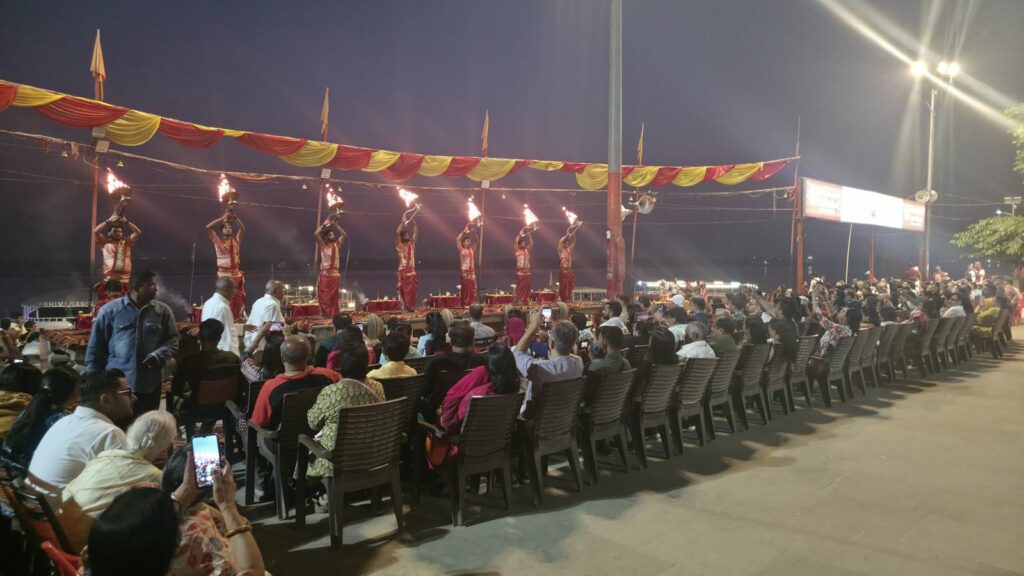
This section is our own account, not the organisers’. Our team went to Assi Ghat early that morning for Subah-e-Banaras. What follows is what we saw and heard that one morning; another day may be different.
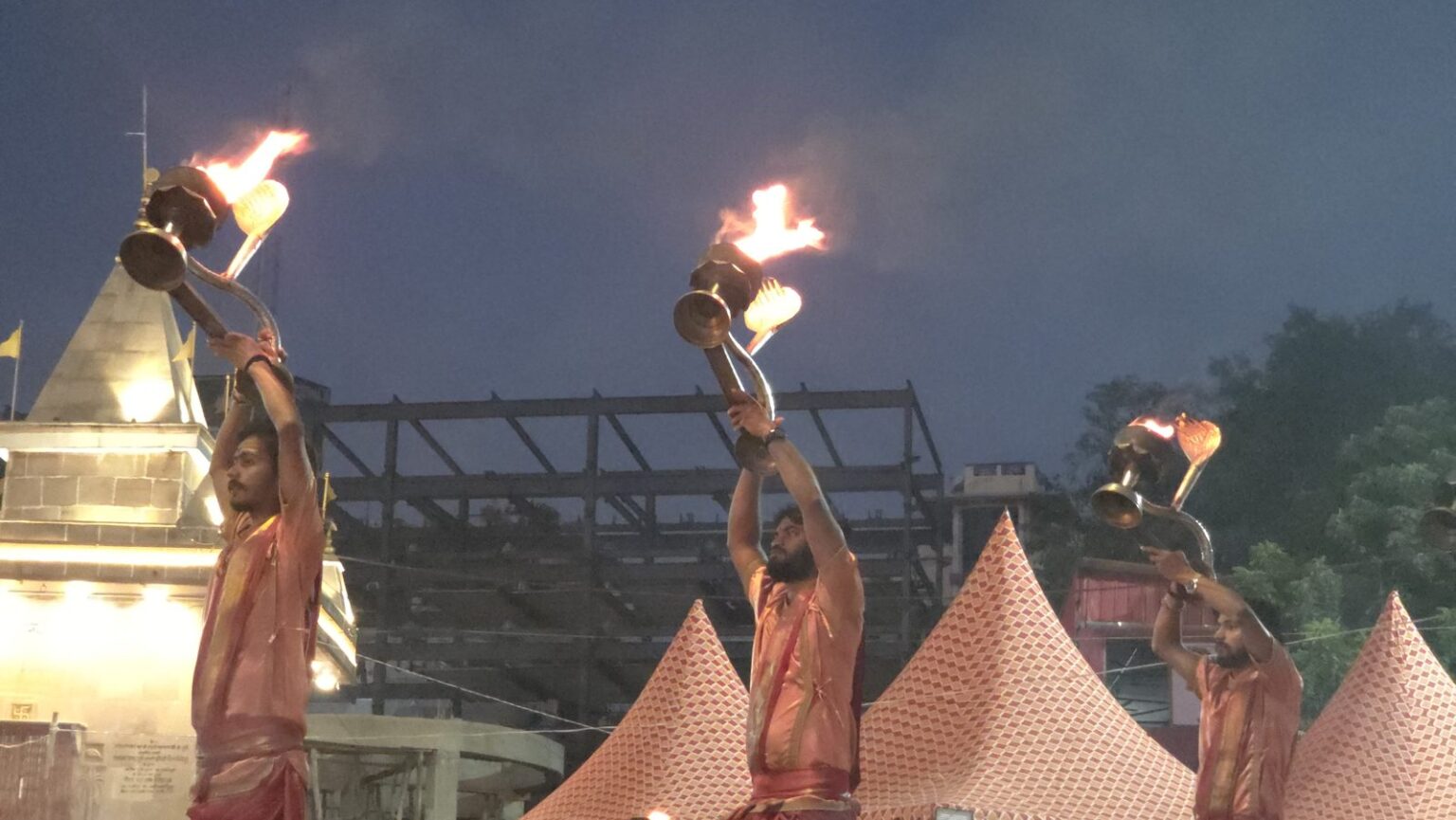
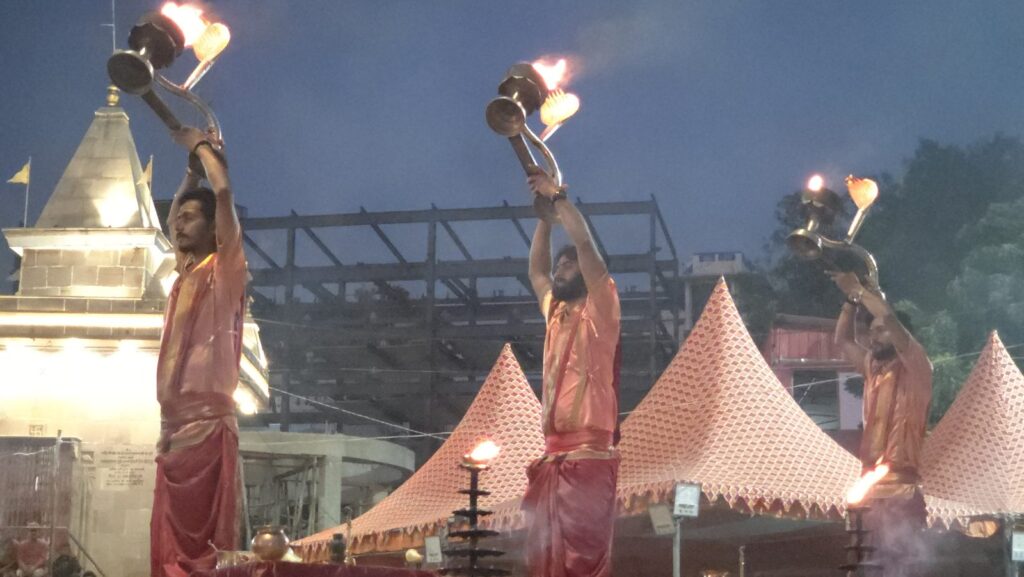
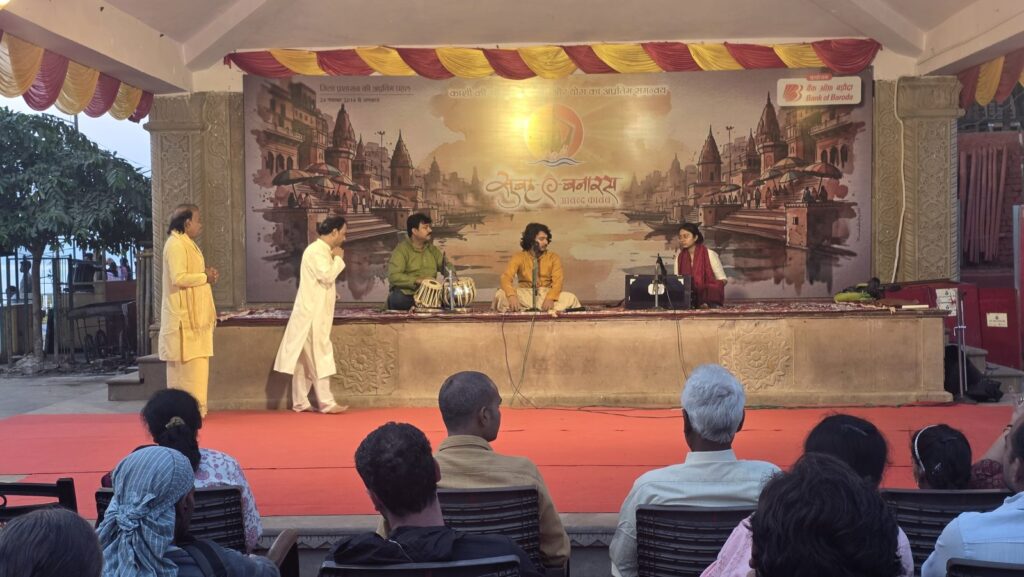
The morning Ganga aarti came first. We found it very peaceful. On the morning we were there, the order matched the organisers’ published schedule: after the aarti came the yagya, and then the music.
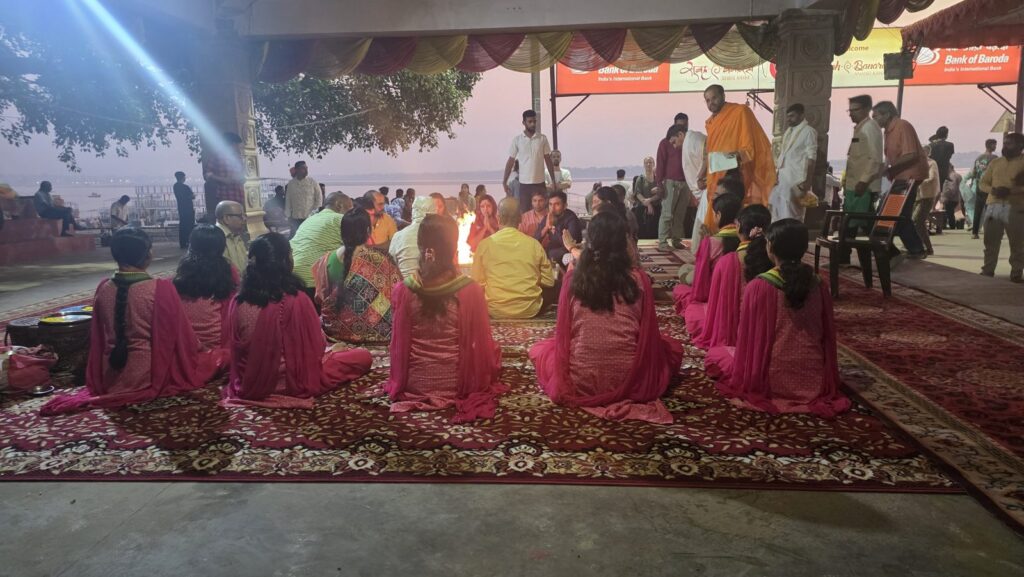
For us, the havan was the most important part of the morning. As the fire offering went on, the mantras could be heard all over Assi Ghat, and the chanting was soothing to listen to. (On who performs the havan, see the next section.)
Then came the sangeet, the live morning music. One of our team put it simply: it calms your brain.
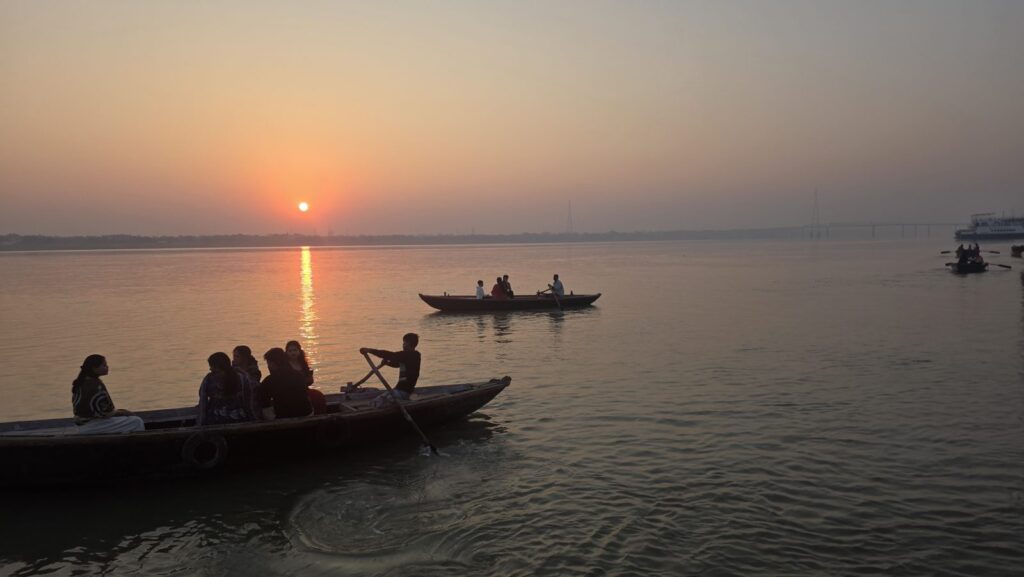
We also went out on a sunrise boat ride from Assi that morning. Out on the water as the light came up, the ride was calming and peaceful, with very positive vibes. For how boat rides work, what to agree with the boatman and safety in high water, see our boat ride guide.
- Arrive before the start time. The organisers’ timings follow sunrise and move a few minutes day by day (see the timing section below), so check the time the day before.
- It is free. The organisers say the programme is free every day, and our hotel confirmed this in October 2026.
- General advice: take your shoes off where you are asked to, especially near the aarti and havan area, and sit where others sit.
- General advice: photograph respectfully. No flash during the ritual, do not step in front of the priests or performers, and ask before photographing people up close. We found no published photography rule.
- General advice: carry a light layer for the riverside before sunrise, even in October.
Who performs the havan
We want to be careful here, because we are reporting what we saw alongside what we could confirm.
What the organisers publish: the Subah-e-Banaras daily schedule includes a Vedic yagya, which the organisers say is “to purify our inner self and world peace”. Their website does not name who performs it. Earlier reporting describes students of Panini Kanya Maha Vidyalaya reciting the Vedas at the programme (see the chanting section above), but we found no current source naming who performs the yagya today.
What we saw: on our visit, the havan was performed by girls and young women, and its mantras carried across Assi Ghat. They are brahmacharinis: they do not marry and devote themselves to Vedic study and ritual. We first took them to be Brahma Kumaris, but we have found no report of a Brahma Kumaris havan at Assi Ghat, and the Brahma Kumaris centre directory for Varanasi lists no centre there.
What research describes: A 2019 research talk by Natalia Korneeva (HSE University) on Vedic recitation at Subah-e-Banaras, and earlier reporting in Open Magazine, say the morning ritual opens with Vedic mantras recited by female students of the Pāṇini Kanyā Mahāvidyālaya, a Vedic school for girls in Varanasi, as part of their training in performing rituals. We have not confirmed that the girls at the havan we watched were from this school, but they are brahmacharinis.
We have also not been able to establish whether the havan we saw was the yagya in the organisers’ schedule or a separate ritual held at the same time. If you would like to join or follow the havan, ask at the ghat on the day, or contact the organisers through their contact page. We will update this section when we can confirm it.
The chanting, aarti and music: what the sources say
Incredible India speaks of a “tranquil ambience” at Assi at sunrise. On the order of the morning, the organisers are specific: the chanting and aarti come first, then the yagya, then the music, and yoga comes last.
Vedic chanting
The organisers’ About page describes the Vedic hymns as “chanting by Rishikas” but does not say who the reciters are. In 2015 Open Magazine reported that girls from Panini Kanya Maha Vidyalaya recited the Vedas in unison. We have not confirmed who leads the chanting today.
The aarti and yagya
The organisers describe a morning aarti with Vedic hymns, followed by a yagya. The Kashi official portal speaks of prayers to the rising sun and the river. No source we found gives the number of priests or lamps, so we do not give them here.
Live morning ragas
The organisers post a notice for each morning’s music, which they call “Prabhati”. Their notices for early October 2026 list classical singers from Varanasi and Sri Lanka, violinists from West Bengal and the Andamans, and a flautist from Chhattisgarh, so the performer changes from day to day. In 2015 The Hindu quoted the convener of the organising committee as saying the event had given a platform to upcoming artists from across India.
Yoga
Yoga closes the programme. UP Tourism names Kriya Yoga, and Incredible India mentions yoga and meditation. We have not confirmed whether visitors need to bring a mat; ask the organisers before you go.
Timing: it follows dawn and the season
The organisers’ About page gives these timings: summer, 4:50 AM to 7:00 AM; winter, 5:40 AM to 7:45 AM, about two hours in all. There is no single changeover day: our hotel’s experience (October 2026) is that the start moves a little earlier each day towards summer and a little later each day towards winter, following sunrise, within these two windows. The footer of the same site says only “daily before sunrise”, depending on the season and the hours of dawn. Timings read on 11 October 2026; they change with the season, so confirm locally the day before.
In practice, check the time with the organisers or at the ghat the day before you go. Their contact details are on the contact page of their website.
Monsoon floods can reach the venue. On 1 September 2026 Patrika reported that the Subah-e-Banaras stage at Assi Ghat was fully under water. We found no report of where the programme was held during that flood. If you are visiting in the monsoon or just after it, check before you set out.
How it differs from the Dashashwamedh aartis
Subah-e-Banaras is a separate programme from the aartis at Dashashwamedh Ghat, and it is held at a different ghat, Assi. For the Dashashwamedh aartis, see our Ganga Aarti guide.
Dashashwamedh evening aarti
Amar Ujala reported on 7 November 2025 that Ganga Seva Nidhi and Gangotri Seva Samiti had moved the evening aarti at Dashashwamedh Ghat one hour earlier for winter, to 6 PM. That is the latest dated report we found, so check locally before you go.
Dashashwamedh morning aarti
In the same passage, the Amar Ujala report of 7 November 2025 said the morning aarti had moved from 5:00 AM to 5:30 AM for winter 2025-26. It does not name who performs it. We found no later report, so check locally before you go.
Subah-e-Banaras at Assi
Subah-e-Banaras is held at Assi Ghat, and the aarti is one part of a longer morning that also includes chanting, a yagya, a music performance and yoga. The organisers give it about two hours.
Watching from a boat
Incredible India lists boat rides among the things to do at Assi Ghat. We found no published source that describes watching Subah-e-Banaras from the river, so we cannot say how much of the stage or the music can be seen or heard from a boat. On our own visit we took a sunrise boat ride from Assi as well as attending the programme (see our visit above).
General advice: a sunrise boat ride is usually taken around dawn, the same part of the morning as the programme, so you may need to choose between the two or go on different days. Boats can be stopped when the river is high. On 15 September 2024 Amar Ujala reported that boat operation on the Ganga had been stopped during a flood. For fares, safety and what to agree before you board, see our boat ride guide.
Near Assi Ghat: Mumukshu Bhawan
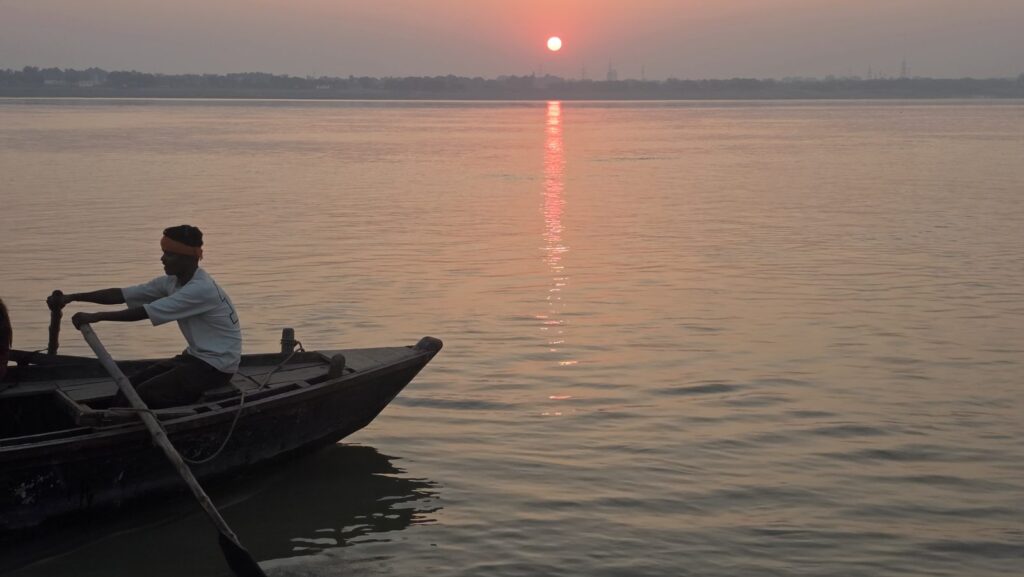
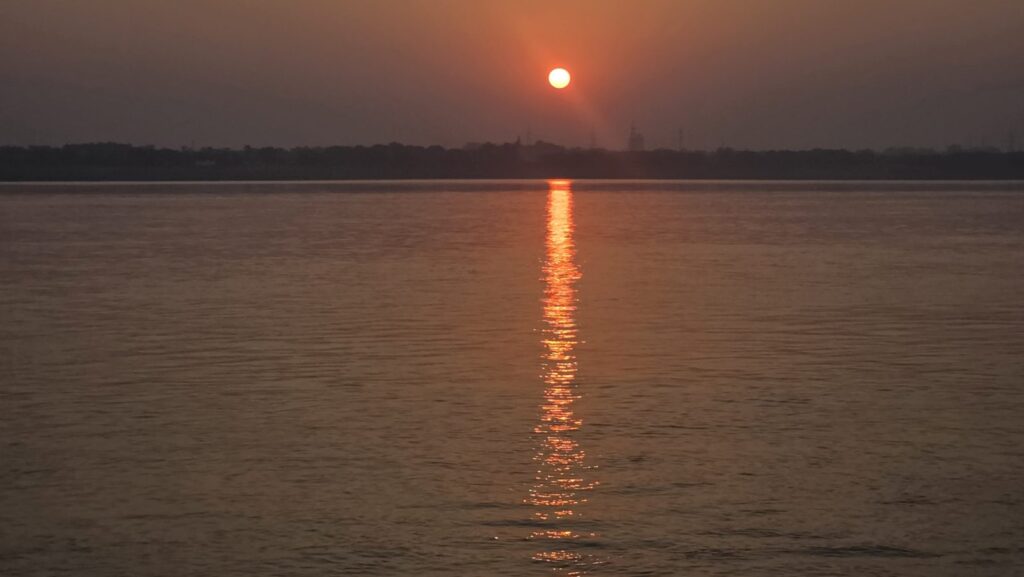
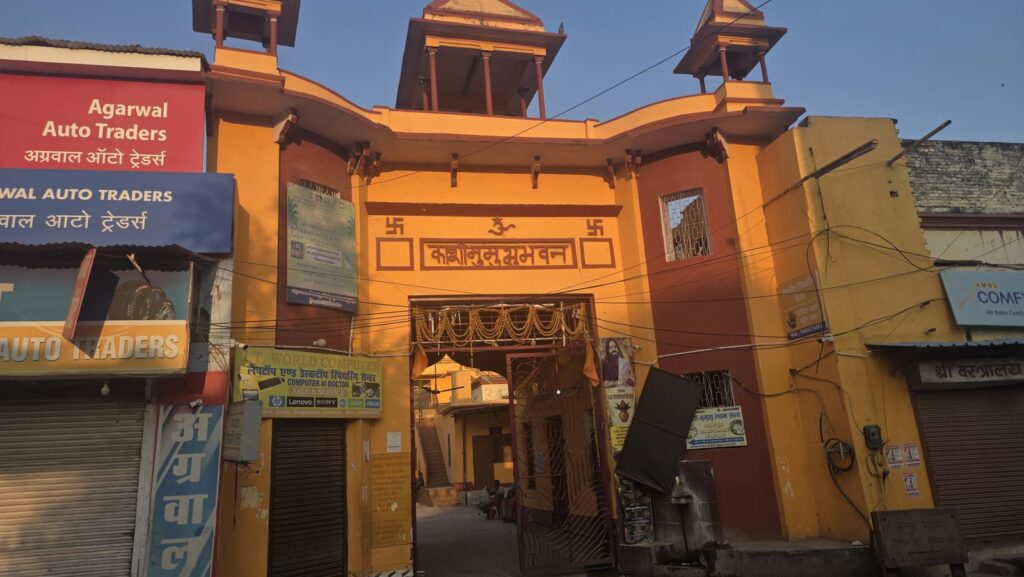
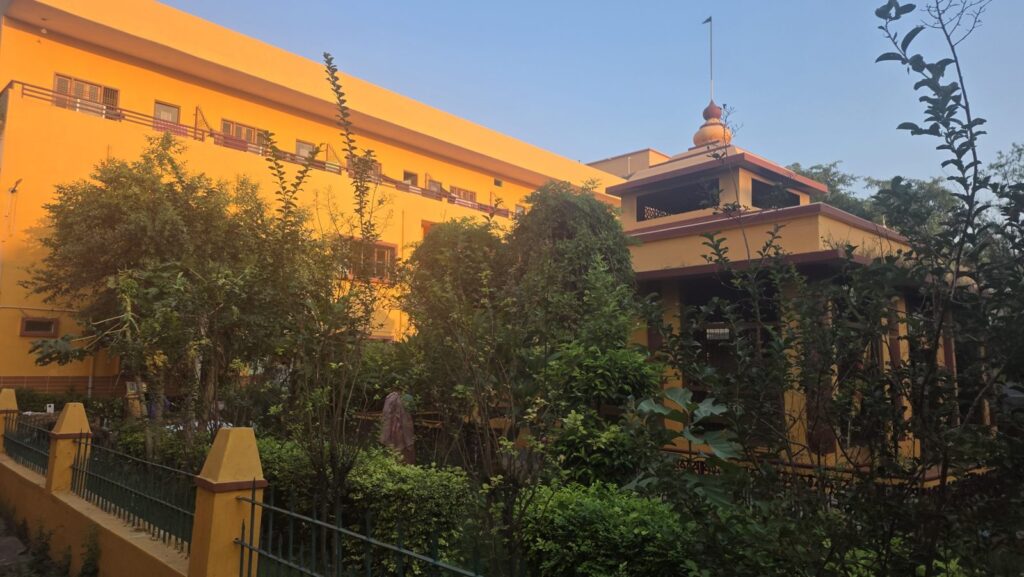
On the same morning our team also photographed Mumukshu Bhawan, a long-established institution at Assi.
Mumukshu Bhawan, Assi
Hinduism Today reported in 2015 that the Kashi Mumukshu Bhawan at Assi Ghat, established in 1920, is run by the Kashi Mumukshu Bhawan Sabha and stands on the campus of the Sabha’s Sanskrit college and gurukulam. It is a home where elderly people come to spend their last years in Kashi, in the hope of moksha (liberation); Gaon Connection reported in 2023 that rooms are given to people over 60, and that the campus has temples and a Sanskrit school. Reports differ on who funded the building, so we do not name a founder. It is people’s home, not a tourist site: general advice, be quiet and respectful outside, and ask before photographing residents. Read our Mumukshu Bhawan guide.
Sunrise boat rides from Assi
Assi is one of the ghats where boats start. For boat types, the reported rate lists, safety and high-water closures, see our boat ride guide.
Practical notes
The first two points come from the sources named. The rest are our general advice for a dawn visit to any ghat, not rules set by the organisers.
- Entry: free. The organisers say the programme is free every day and is supported by contributions, and our hotel confirmed this in October 2026. Their website also has a paid seat-booking page; you do not need it to attend.
- Venue: the organisers refer to artists performing on stage, Open Magazine described a stage for the morning music in 2015, and Patrika referred to the Subah-e-Banaras stage at Assi Ghat in 2026. We have not checked where visitors sit on a normal morning.
- General advice: arrive before the start time, as the chanting opens the programme.
- General advice: dress modestly and carry a warm layer on winter mornings by the river.
- General advice: keep quiet during the chanting, aarti and music, and keep your phone on silent.
- General advice: ask before you photograph people, especially the reciters and priests, and avoid flash during the ritual. We found no published photography rule for the programme.
- General advice: the ghat steps can be slippery in the dark and after rain, so take care.
From Hotel Vinayak Plaza
Assi Ghat is about 2.2 km by road from our hotel (Google Maps, 5 October 2026), a short auto or cab ride. Our reception is staffed 24×7 and books autos and cabs for guests. For a pre-dawn start, tell the desk the evening before. For more on the area, see staying near Assi Ghat, or see the rooms.
Call or WhatsApp +91 91992 67480 (enquiries). Phone calls are answered 24×7. Address: Sankat Mochan Rd, near Sankat Mochan Temple, Saket Nagar Colony, Sankata Mochan Leprosy, Varanasi, Uttar Pradesh 221010. You can also contact the hotel by email.
Questions about Subah-e-Banaras
What time does Subah-e-Banaras start?
It starts before sunrise and moves a few minutes day by day with sunrise: earlier towards summer, later towards winter. The organisers’ website gives the range as 4:50 AM to 7:00 AM in summer and 5:40 AM to 7:45 AM in winter (read on 11 October 2026); there is no single changeover day. Confirm the time locally the day before.
Is there an entry fee for Subah-e-Banaras?
Yes, entry is free. The organisers say the programme is free every day, and our hotel confirmed this in October 2026. Their website also offers paid seat bookings, which you do not need to attend.
What happens at Subah-e-Banaras?
According to the organisers, the morning runs in this order: Vedic chanting, an aarti with Vedic hymns, a Vedic yagya, a classical or semi-classical morning raga performed live, and then yoga.
Is Subah-e-Banaras the same as the Dashashwamedh Ganga Aarti?
No. Subah-e-Banaras is held at Assi Ghat before sunrise and includes chanting, an aarti, a yagya, music and yoga. Dashashwamedh Ghat has its own morning and evening aartis, which Amar Ujala reported on 7 November 2025 at 5:30 AM and 6 PM for winter 2025-26; check locally before you go.
What is the morning Ganga aarti at Assi Ghat like?
On our visit in October 2026 we found it very peaceful. It is part of Subah-e-Banaras: the aarti was followed by a yagya and then live morning music, the order the organisers publish. Arrive before the start time; entry is free.
Who performs the havan at Assi Ghat in the morning?
The organisers’ schedule includes a Vedic yagya but does not name who performs it. On our visit in October 2026, the havan was performed by girls and young women who are brahmacharinis (they do not marry). Published research says female students of the Pāṇini Kanyā Mahāvidyālaya, a Vedic school for girls in Varanasi, recite the opening Vedic mantras; ask at the ghat on the day to know more.
What is Mumukshu Bhawan near Assi Ghat?
According to Hinduism Today (2015), the Kashi Mumukshu Bhawan at Assi Ghat was established in 1920 and is run by the Kashi Mumukshu Bhawan Sabha. It is a home where elderly people come to spend their last years in Kashi, on a campus with a Sanskrit college. It is a residence, so please be respectful.
सुबह-ए-बनारस में क्या होता है और क्या इसका कोई शुल्क है?
आयोजकों के अनुसार अस्सी घाट पर सूर्योदय से पहले क्रम से वैदिक मंत्रपाठ, वैदिक ऋचाओं के साथ आरती, वैदिक यज्ञ, शास्त्रीय या उपशास्त्रीय प्रातःकालीन राग का सजीव संगीत और फिर योग होता है। प्रवेश निःशुल्क है; इसके लिए किसी सशुल्क सीट की ज़रूरत नहीं है। आयोजकों की वेबसाइट के अनुसार समय गर्मियों में सुबह 4:50 से 7:00 बजे और सर्दियों में सुबह 5:40 से 7:45 बजे के बीच रहता है और सूर्योदय के साथ रोज़ कुछ मिनट बदलता है, इसलिए एक दिन पहले स्थानीय स्तर पर समय की पुष्टि कर लें। 22 अक्टूबर 2026 को हमारी टीम को सुबह की आरती, हवन के मंत्र और संगीत बहुत शांतिदायक लगे।
Who organises Subah-e-Banaras?
Its website lists a committee whose patrons include the Mayor, the Police Commissioner, the Divisional Commissioner and the District Magistrate of Varanasi. The chairman is the Commissioner of Varanasi Division, and Dr Ratnesh Verma is listed as CEO and Secretary.
How do I reach Assi Ghat from Hotel Vinayak Plaza before dawn?
Assi Ghat is about 2.2 km by road from the hotel, a short auto or cab ride. Our reception is staffed 24×7 and can book an auto or cab; tell the desk the evening before.
Sources and last checked
The facts on this page come from these sources, read on 11 October 2026; the havan and Mumukshu Bhawan sources were read on 23 October 2026. News reports are given with their dates. The section on our visit is our own team’s experience of that one morning.
Details can change with the season, floods and festivals. If you notice something out of date, please contact us. See also the Varanasi guide, places to visit in Varanasi and the Kashi Darshan guide.
- Subah-e-Banaras official website: home page and daily schedule
- Subah-e-Banaras: About (timings and committee)
- Subah-e-Banaras: Events (Prabhati music notices)
- District Varanasi (Government of Uttar Pradesh): Subah-e-Banaras event page
- UP Tourism: Assi Ghat
- kashi.gov.in: Assi Ghat
- Incredible India (Ministry of Tourism): Assi Ghat
- The Hindu, 23 March 2015: Subah-e-Banaras a hit as Assi ghat gets a makeover
- Open Magazine, 20 May 2015: Varanasi: A pause in eternity
- Amar Ujala, 7 November 2025: winter change in aarti timings (Hindi)
- Amar Ujala, 15 September 2024: flood, aarti sites and boats (Hindi)
- Patrika, 1 September 2026: Varanasi flood report
- Brahma Kumaris (official): Varanasi centres
- Hinduism Today, July 2015: To Die in Varanasi (Kashi Mumukshu Bhawan)
- Gaon Connection, 25 July 2023: Waiting to Die in Kashi (Mumukshu Bhawan)